GymAI gives every gym a free account. It is not a trial, it has no end date and nobody will ask you for a card. It exists for one reason: so that the people who train at your gym get the machines you really own, and so that the record of your gym on the GymAI map is kept by you, not by strangers. It is the same account for an independent gym with one room and for a chain with fifty sites: every gym fits. This article explains what the account holds, what it will never do, how it is protected, how you claim a gym that is already listed, and why it is worth being there when GymAI opens.
What a free gym account is
A free gym account is the gym’s own place on GymAI. It does one job: it says what your gym has, and keeps saying it. Your name, where you are, how we reach you, the machines on your floor and the services you offer. Nothing else.
That record is public. Anybody looking for somewhere to train can find it on the map, and anybody training with GymAI can say I train here. From that moment, their plan is built around your equipment: the exercises they are offered are the ones your floor can actually support, and the machines you do not own stop appearing.
There is one kind of gym account, not two. It is the same account whether you registered first or arrived later to claim a record somebody else had already created.
What your gym gets
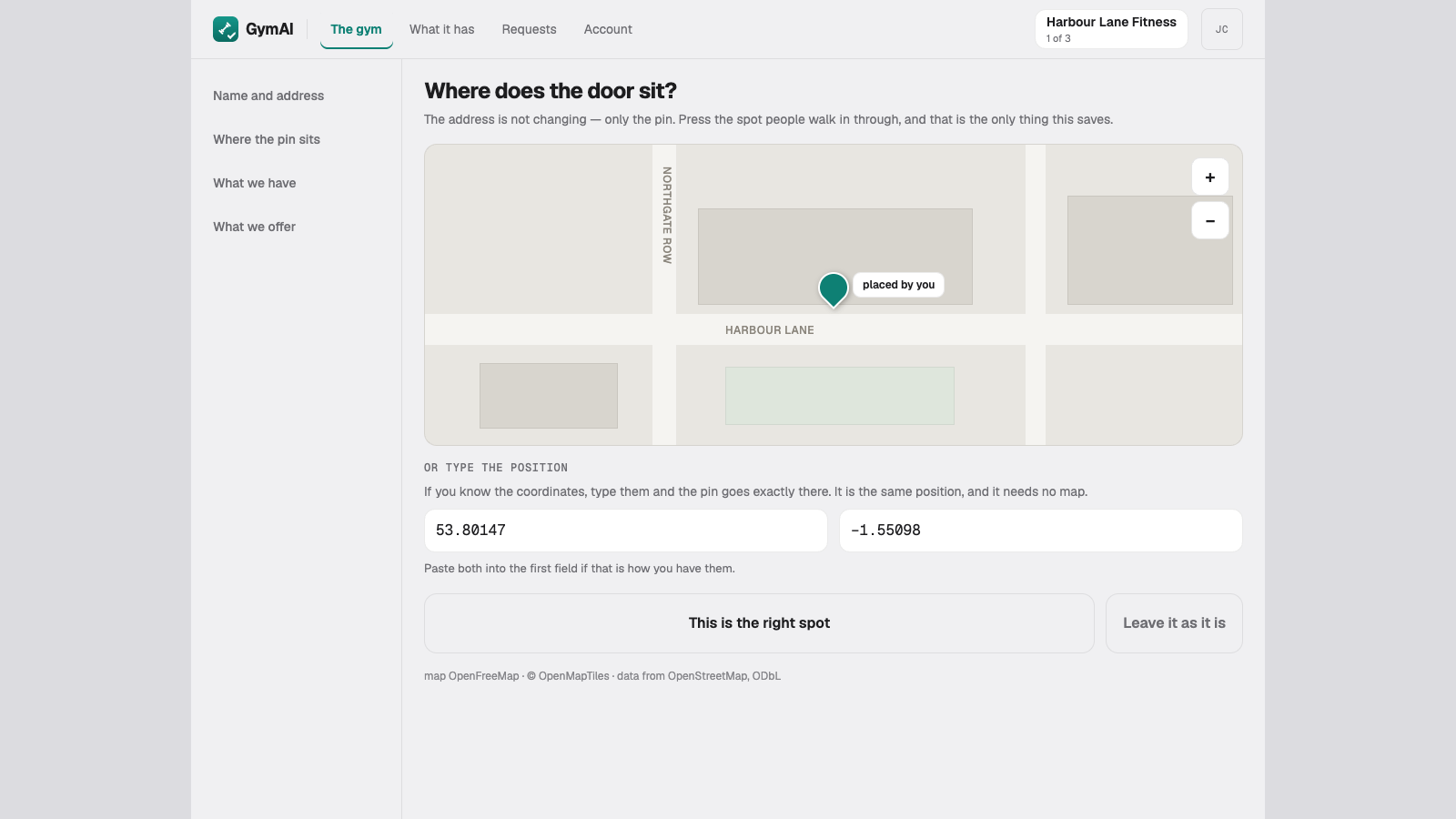
- A place on the map. Your gym, pinned on the exact door, with its address and a short access note for what a postal address cannot say: the side entrance, the second floor, the bell to ring.
- Members who arrive already set up. A person who chooses your gym gets your exact equipment without ticking two hundred boxes. Their plan fits your floor from the first session.
- A record that is yours. What the gym publishes about itself outranks what users contributed. Without an account, your record is whatever other people remember about your gym.
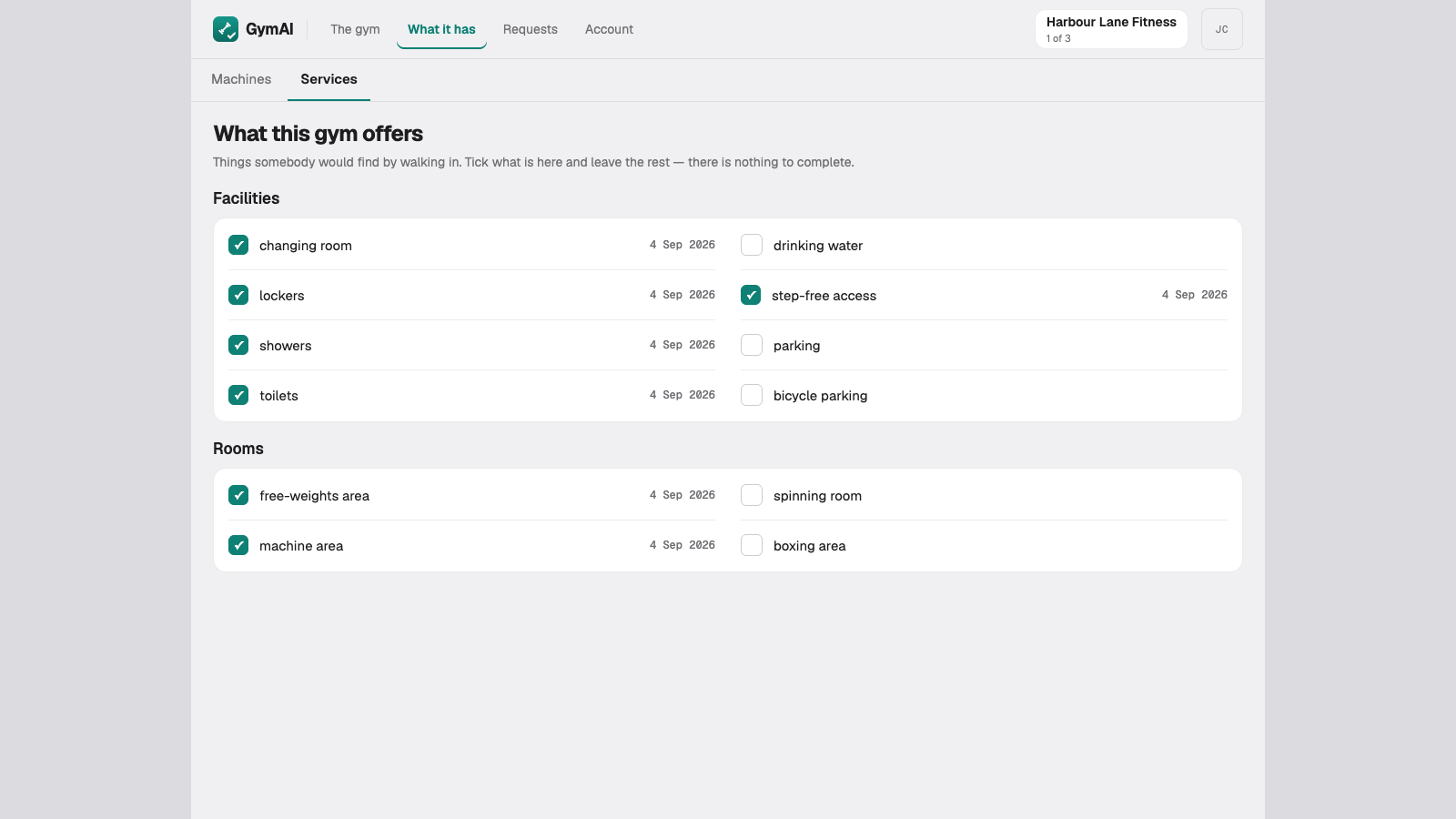
- Your services, listed. Lockers, showers, a yoga room, a sauna, exercise halls: chosen from a closed list, so a visitor can search for them and nobody can write nonsense on your page.
- Room for every gym. A single independent gym or a chain with many sites: one account keeps as many records as you run, each with its own address and inventory.
- No cost, no expiry. The account is free today and it does not turn into a paid plan after a few weeks.
The five things the account holds
The boundary is deliberately small, and it is the whole specification. A gym account holds exactly five things:
- Your name.
- Your address, structured, with the point on the map where the door sits, placed by a person rather than guessed, and an optional access note of up to 120 characters.
- An address we can reach you at. An email at the gym, where the codes and every notice about your record arrive.
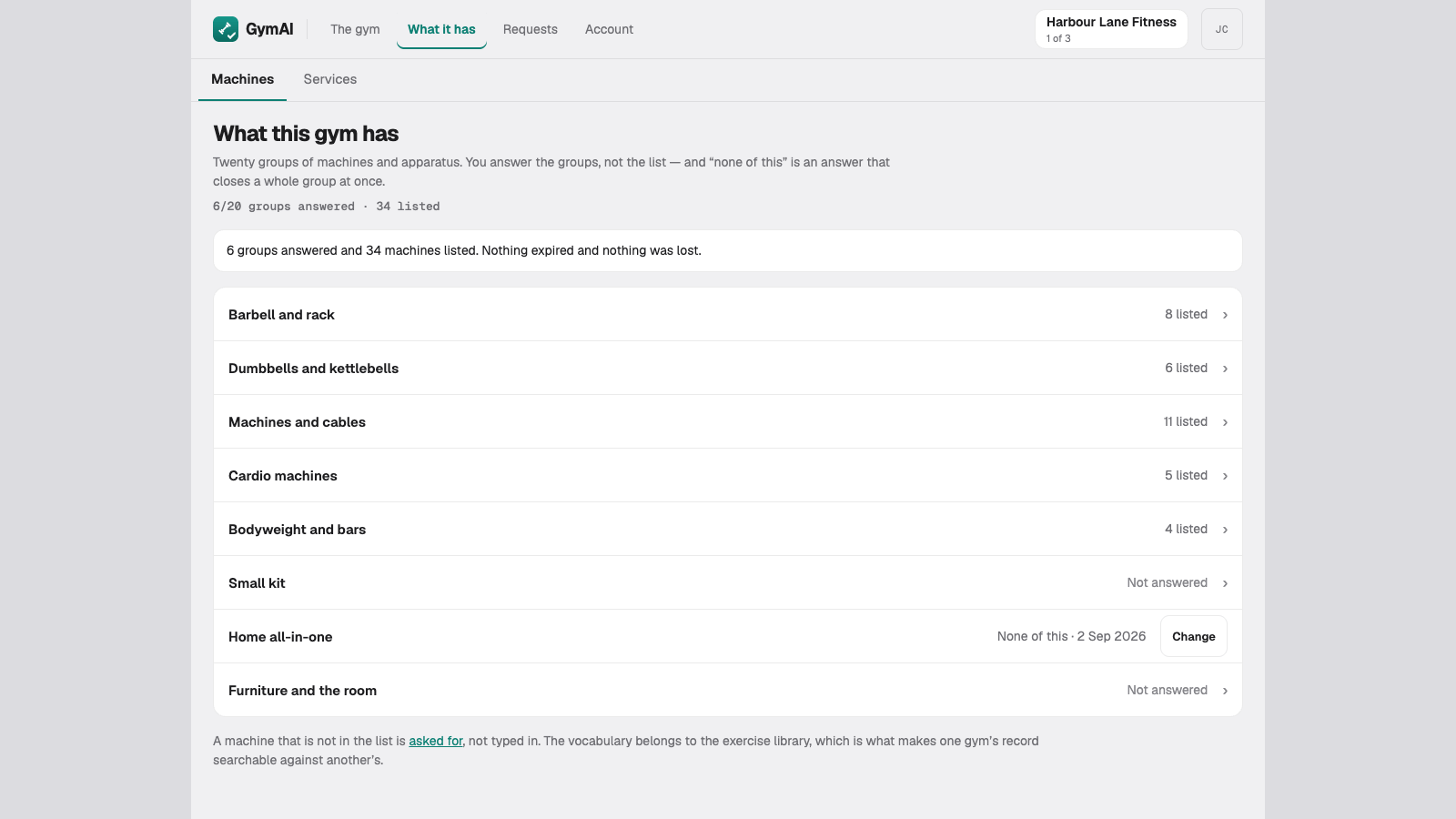
- What you have: your machines and equipment, picked from GymAI’s equipment vocabulary. The exercises your gym can support are worked out from this list, so you never fill them in and they always match what is actually on the floor.
- What you offer: your services, picked from a closed list.

Every tick saves at once. If a whole group does not apply to you, one answer, None of this, says so. And if you own a machine that is not on the list, you can ask about it with a short description, the muscle group it works and its make. A person reviews the request; if it is already on the list under another name, you are shown where to tick it.
What the account will never do
What a free gym account refuses matters as much as what it holds, and these limits are part of the design, not a missing feature:
- It trains nobody. No plans, no routines, no sessions, no history.
- It holds no members and sees nobody. GymAI knows which gym a person chose. The gym is never told who chose it: not a name, not a number, not a visit.
- It never reads health information. Not a single datum about anybody.
- It has no free text. Everything on your record comes from closed lists, so it cannot become a notice board with somebody else’s words on it.
- It publishes no photographs. Images bring storage, moderation, the people who appear in them and their image rights, and none of that answers the one question the record exists for: what does this gym have.
That is also why we never ask how many members you have. We do not need to know, and we do not want to hold it.
Why it is free, and why that is not a trial
The free account is not charity. It is what makes GymAI work in the real world. A person who says I train at this gym should get the right machines without describing a whole room by hand, and a map of where people train is only worth something if the information on it is true. Gyms describing themselves is how that happens.
So the account is free for as long as it does what it does today. Paying is a separate decision, never an expiring trial: it gives a gym its own GymAI instance to serve its own members. You never need it to be on the map.
How your account is protected
A record that tells people where to go and what they will find there has to be hard to take over. The protections are built in from the first screen:
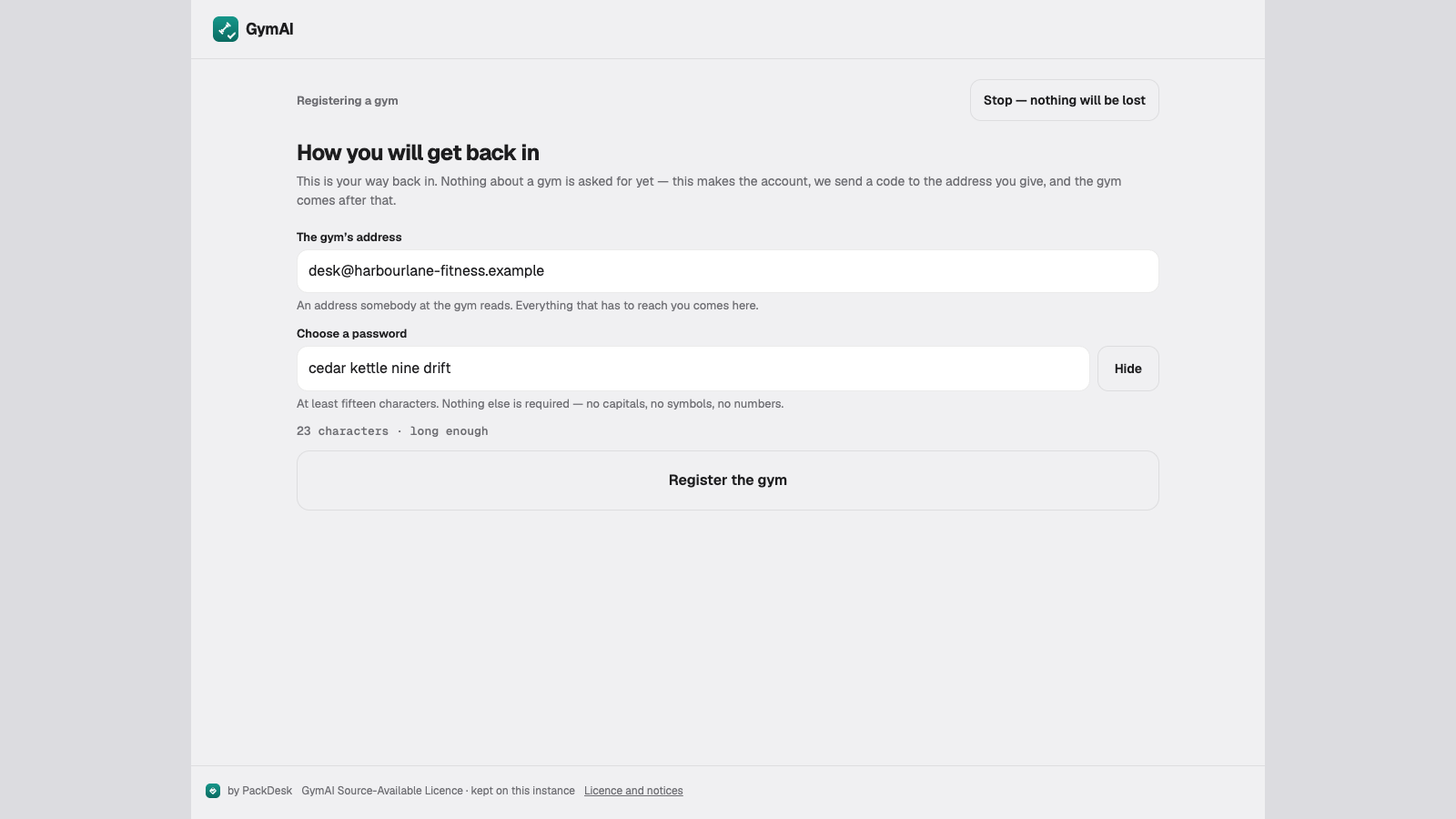
- Long passwords, without silly rules. Between 15 and 256 characters, and common passwords are refused. No forced mixes of symbols and capitals.
- Passkeys. You can sign in with a passkey instead of typing a password.
- A confirmed address. A new account receives an eight-character code by email. It works once, for 24 hours, with five tries. An account that is never confirmed can do nothing and is deleted after seven days.
- A second way of proving it is you. Changing anything on a record needs a confirmed address and a second factor: an authenticator app, or two passkeys.
- Sign-in that gives nothing away. A failed attempt never says whether the address or the password was wrong, and repeated attempts are slowed down.
- Safe password recovery. A reset code lasts 30 minutes, with five tries, and changing the password signs out every other device.
- Your ways in, visible. The account page lists each way you sign in, when it was added and when it was last used. You can take one off, but never the last one.
Claiming a gym that is already listed
People who train with GymAI can add the gyms they use before those gyms have an account. That is how the map fills up. When you arrive, you may find your gym already there, and you can claim it.
The first step is always a search: Start here — is your gym already listed? If it is not, you add it and put the pin on your door. If it is, you ask for it with This is us.
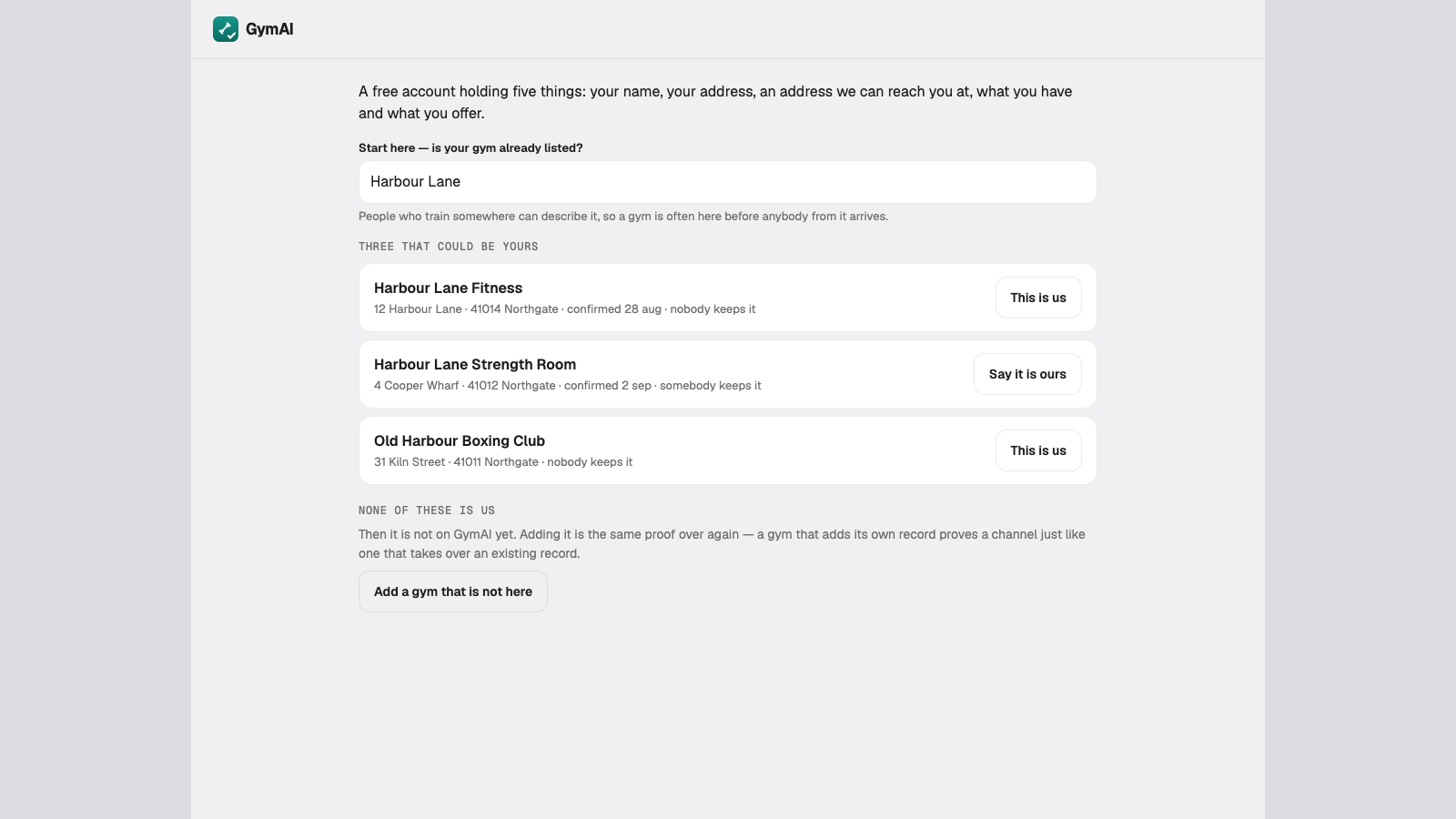
Nobody is given a gym by asking for it. A claim is proved through a channel your business already publishes, and today that means email at your own website’s domain:
- You give the gym’s website.
- You type an address at that website’s domain. Free email providers never count, so a claim cannot be made from a throwaway mailbox.
- GymAI sends an eight-character code to that address. It works once, for 24 hours, with five tries.
- You type the code back. That proves control of the domain, and grants nothing yet.
- A person checks the claim, usually within a few days, and only then does the record become yours.
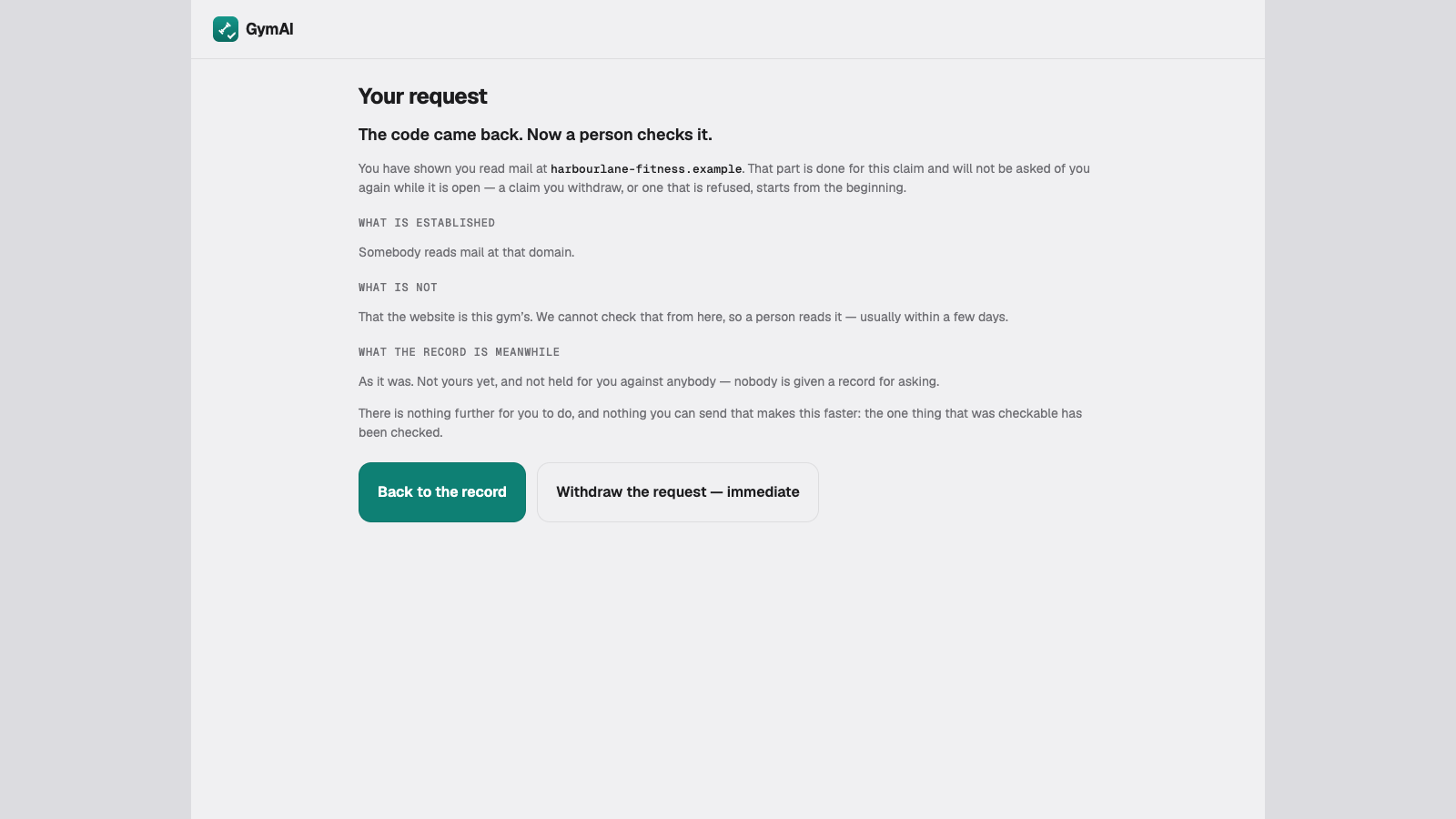
We are careful with the wording: a proved claim does not say verified owner, because no email proves who owns a building. It says how the claim was proved. If a claim is refused, you are told, and you can start a new request. A gym with no website of its own cannot be claimed yet.
If you ever close the account, the record stays. It goes back to being unclaimed with its content intact, because a record that vanished with an account would take a neighbourhood’s inventory with it.
If somebody else claims your gym
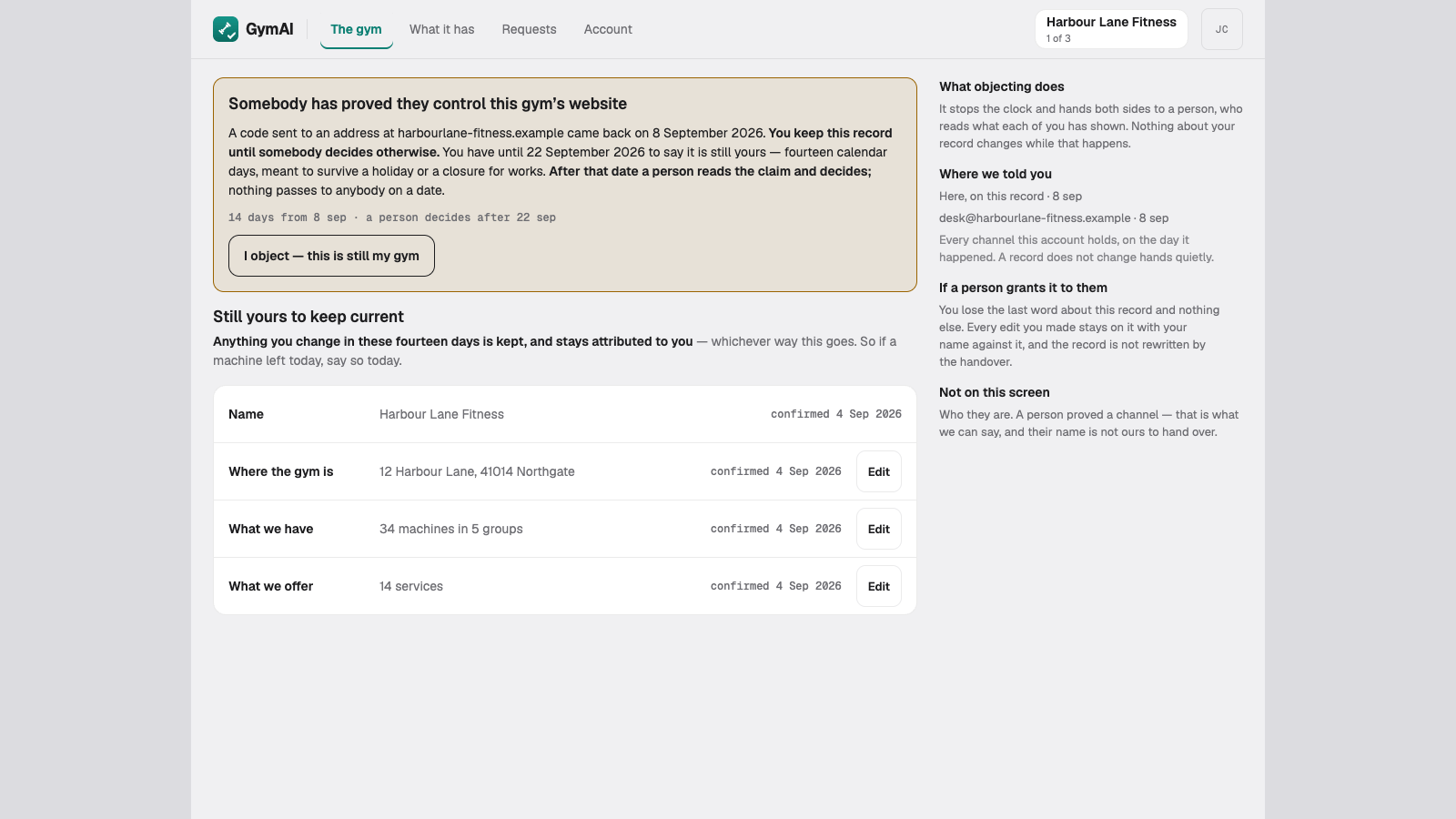
A record that is already kept can be claimed again, and that is exactly where most takeovers happen elsewhere. On GymAI, a date never hands a gym to somebody else.
- When somebody proves control of your gym’s website, you are emailed at once, and your console shows it.
- You have fourteen calendar days to answer with I object — this is still my gym. An objection made after those days still counts, until a person decides.
- The notice is retried until it is delivered, so a mail server that is down cannot swallow your only warning.
- You are never told who claimed the record or where their code was sent.
- A record changes hands only when a person on GymAI’s side has seen both sides.
Keeping the record current
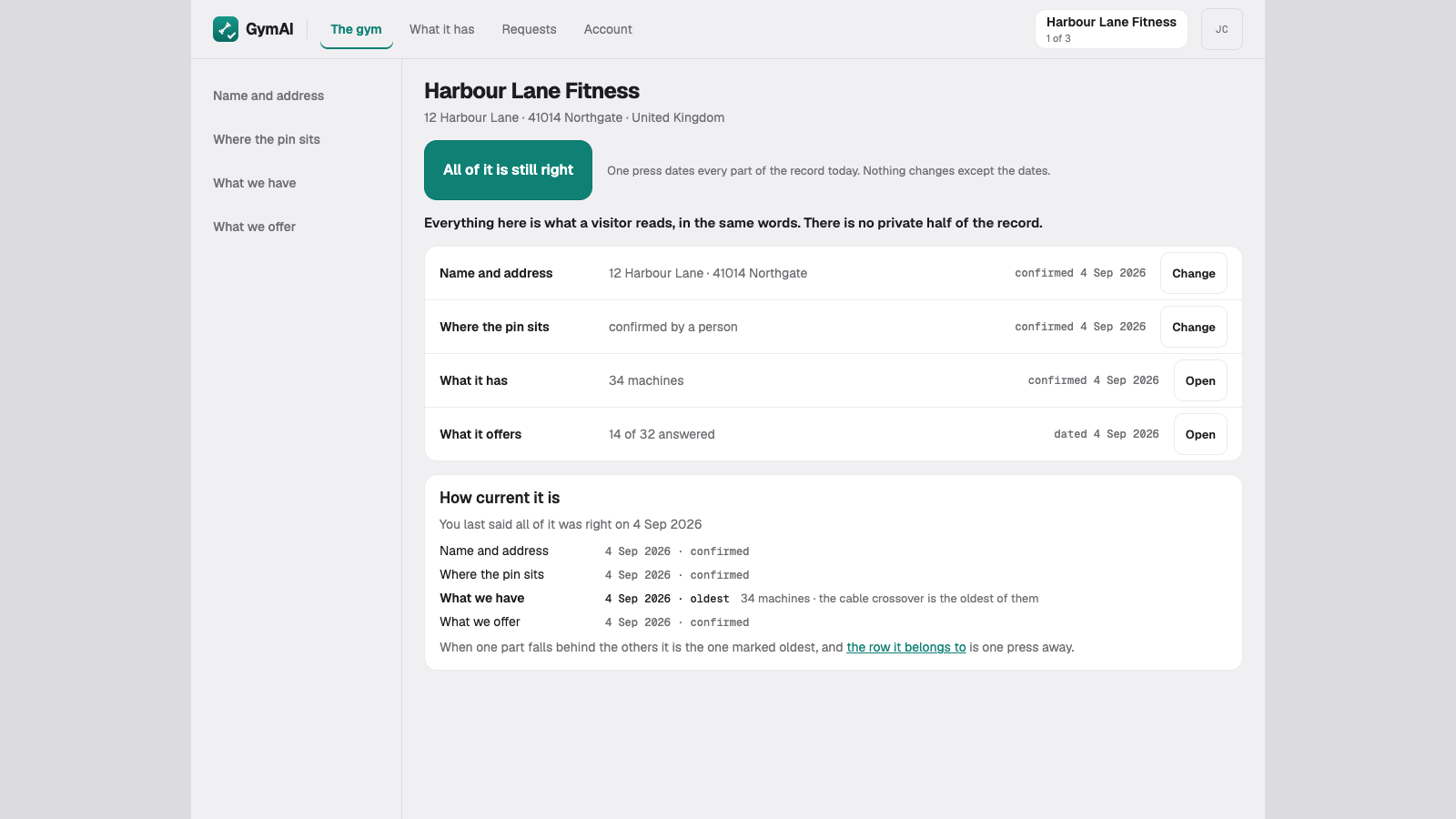
Equipment changes, and a map is only as good as its freshest record. Your console shows how current each part of the record is and marks the oldest one. When nothing has changed, one button, All of it is still right, dates the whole record today. If you move, you change the address and place the pin again.
One gym or a whole chain: every gym fits
The free account is built so that every gym can be on the map, whatever its size. A neighbourhood gym with a single room, a functional training box, a climbing wall, a municipal sports centre and a national chain all use the same account, with the same rules and the same protections.
- If you run one gym, you describe that one place and keep it current. That is all.
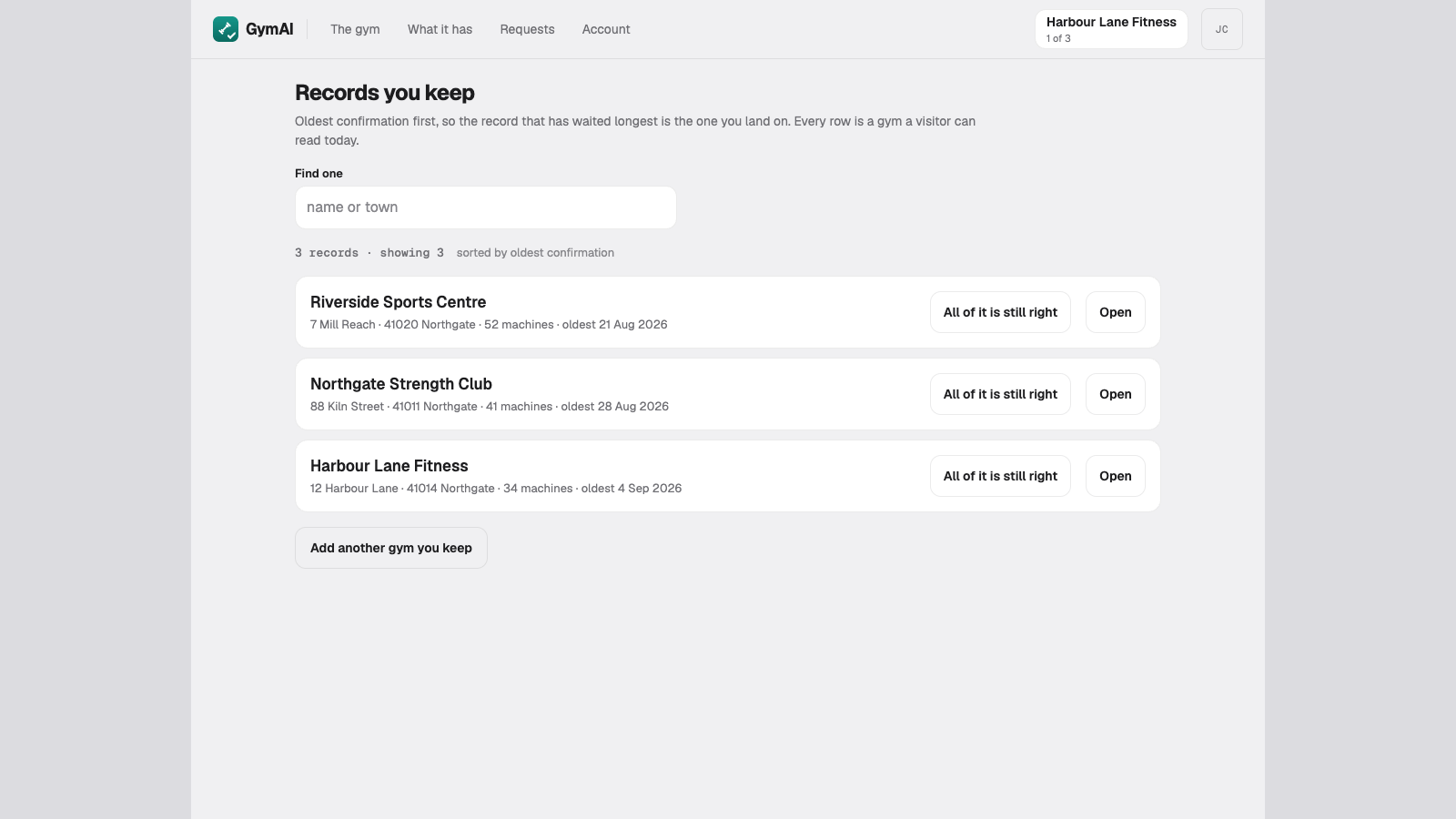
- If you run several, one account keeps them all. At the top of your console, the record’s name opens a list of every gym you keep, and a single screen shows them all, oldest confirmation first.
- If you run a chain, each site is described separately, with its own address, pin, machines and services. The equipment differs from one site to another, and an inventory averaged across sites is wrong everywhere.
Nobody is too small to be listed, and nobody is too big to describe each site properly.
Why your gym should be on GymAI
A person’s training is usually split between four places that never talk to each other: the gym, the personal trainer, the physiotherapist and the dietitian. GymAI is where that chain is joined, and your gym’s record is the piece that connects a person’s plan to a real floor. Being there early means:
- You shape the map. The first centres on the list are the ones that form it.
- You control what is said about you. Otherwise the record is written by whoever trains there.
- Your members train with what you have. Fewer plans built around machines you do not own, fewer people improvising.
- It costs nothing and asks nothing sensitive. No card, no member numbers, no health data, no photos.
Frequently asked questions
Is the gym account really free?
Yes. It has no price, no trial period and no end date. Paying is a separate choice that gives a gym its own instance for its own members, and it is never required to be on the map.
Will my gym see who trains there?
No. A gym account never sees who chose it: no names, no counts and no visits.
Can I upload photos of my gym?
No. The record holds your name, address, equipment and services only.
My gym is already on the map. What do I do?
Search for it, choose This is us and prove the claim with an email at your website’s domain. A person checks it before it becomes yours.
Can I claim my gym with a Gmail or Outlook address?
No. Free email providers never count. The address must be at your gym’s own website domain.
What if somebody tries to take my gym’s record?
You are emailed, you have fourteen days to object and your objection still counts afterwards. Nothing changes hands on a date alone.
I only have one small gym. Is this for me?
Yes. The account is the same for a single independent gym as for a chain, and a map is only complete if small gyms are on it too.
I run a chain. Do I need one account per gym?
No. One account keeps several records, one per site, each with its own equipment.
How to get your gym on the map
GymAI is being built in the open, and you can follow every step in the dev log. If you run a gym or a sports centre, add it to the waiting list on gymai.coach. Joining the list creates no account, publishes nothing and claims nothing. We write to you when we open, and your gym is ready to be described.



No comments yet
Nobody has written anything here. You can be the first.